

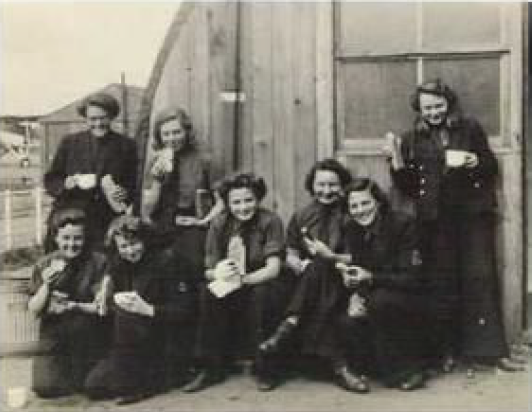
Radio Section, HMS Merlin, Donibristle, nr Inverkeithing, Fife. Summer 1944. Kneeling, front left:Win Clunie. Standing, rear left: Joan Chamberlain. Names of remainder are not now known (second from right Julia Carruthers)
AIRWAVES’: A WREN Radio Mechanic in the Fleet Air Arm, 1941-46
Serving with the Fleet Air Arm as a Petty Officer Radio Mechanic in the WRENS was a truly life-changing experience, and one I would not have missed for the world. It was a mixture of extremely hard work in all weathers, funny, sad and dangerous, but always with a great sense of purpose and comradeship. We were a small band of women from all walks of life with a common aim to do something for our country.
It was January 1941. I was sent to London to Golden Square (in Soho) where we underwent two weeks of ‘make or break’ training. We scrubbed floors, cleaned windows, learned how to march, did P.E. every morning, and slept on the hardest mattresses on the floor every night. Every day we travelled by tube in our overalls to Mill Hill for training. At the end of the two weeks, we could either stay or leave — nobody left! We were then separated into our various categories, sent home, and told to wait for our postings.
I was sent to a wonderful place called ‘Hornby House’ (the home of the maker of Hornby trains) at the corner of Cheyne Walk on Chelsea Embankment. It was a beautiful house overlooking the River Thames. There, thirty-six of us would be Radio Mechanics. We were issued with our uniforms — navy skirt, jacket (black buttons with the naval crest — brass ones came with promotion to Petty Officer), white shirts with stiff collars, black tie, flat cap with Naval ribbon, flat black shoes, and joy of joys, black silk stockings! We had two navy blue shirts for working gear, and most amusing of all, bell-bottom trousers. These were intended for Seamen, not women, so we had great fun cutting some bits out and sewing up the waists to fit the female figure.
We were divided into two sections, one to go to Chelsea Polytechnic for training, the other to go to Battersea Poly. This training lasted for nine months with a professor from Cambridge University trying hard to teach us Physics, Maths and Electronics. We walked to the college and worked each day from 8.30am — 5.30pm, with an hour for lunch. It was very hard work.
Whenever my fiancé Tom Hayhurst came home on leave from his Royal Artillery Unit (51st Highland Division, Medium Artillery), we would have a revision session, which helped. Occasionally, we would get tickets for The Proms. Our pay was fifteen shillings (75p) per fortnight, so we couldn’t afford much! I could only go to the theatre when Tom was on leave (he was training to be an officer, so had more cash!).
We went to dances at the Forces’ Club, we made friends with the wonderful Chelsea Pensioners, and we saluted every bit of gold braid we saw — sometimes it was nothing to do with the Navy! Naval ships sailed down the Thames and the crews waved madly when they saw us. Every night for weeks we heard the bombs raining down and saw the searchlights criss-crossing the river. We were too tired to go to the shelters, so we stayed put, hoped and prayed.
Exam time soon came. We knew that if we didn’t pass, we would be transferred to the ATS. That was unthinkable, so we worked hard! We were shown how electricity was generated from huge dynamos, and we learnt all about magnetism. We were also told how to flatten ourselves against a wall if a Naval Officer was passing. We were taken to the outskirts of the Palace and had to march past the Duchess of Kent for a final salute before being sent on to the next stage of our training after a week’s leave. We all passed the exams with flying colours.
After our week’s leave, we had the biggest cultural shock when we were sent to HMS Ariel at Culcheth, near Warrington for ‘practical, hands-on’ training which lasted for three months. After our luxurious Hornby House, it looked awful. Our accommodation was in long Nissen huts, with 36 of us in each hut and only one cast iron stove in the middle for heating. The
ground was muddy, and we were cold! A bugler sounded ‘Reveille’ every morning at 6am. P.T. was in the bitter cold weather for one hour, we had to do ‘Square-bashing’ every evening, and in between we had lectures on the various radio sets with valves and circuits and coils and resistors! We were taken to a foundry and taught how to make our own tools from pieces of steel — a screwdriver, a chisel, and a marlin spike, which I still have! We were also taught how to splice a rope, how to solder wiring, and how to use an ammeter. We were given circuits to repair and were taught about the differences between the radio wavelengths. All the time we were cold, and longed to see our loved ones who were being constantly blitzed by the German bombs.
Tom used to come to meet me on Culcheth Station, and the Station Master let us sit by the fire in the waiting room, and he lent us his lamp for lighting. That was our little bit of heaven!
Three months passed and it was exam time again. This time, it really was the FINAL, and we were really apprehensive. If we didn’t pass this time, we would have to stay another three months and do it all again with the next batch of trainees. Two of us didn’t pass and had to stay. The rest of us were sent home for a week’s leave and to await our final posting. We were sad because we had all been together for a long time, and now we were going to be split up. Farewell parties were held with our male counterparts — all young Radio Mechs like us. I have to say that although we lived close together, there was no harassment of any kind. This may be unbelievable by today’s standards, but true all the same. We sewed the men’s’ badges
on, we repaired their pullovers, and they would give us their rum rations when we had colds. Later on, in the war, we had news of the few who had gone on to aircraft carriers, and who never returned.
For a few days of my leave, I went to London to meet Tom who was also on leave prior to being sent to India and the Far East. It was with aching sadness that we parted, knowing that it could be for the last time. Back at home, my official posting was waiting for me — to HMS Merlin, Donibristle, near Inverkeithing, Fife. I had a brief visit to the naval dentist and when he enquired where I was going, he said “That’s the last place God made.” I felt really cheered!
It was now January 1942, and I was on the train bound for Scotland, feeling very much alone and uncertain. Fortunately, there were some men from the Argyll and Sutherland Highlanders on the train, and they took care of me. When we got to Carnforth station at about five in the morning, they fetched me a cup of tea and some bacon butties provided by the truly wonderful ladies there. Soon I began to feel a little better. I had to change trains at Edinburgh, and I was kindly directed to the right train for Donibristle (- ‘Donibee’ to everyone). I got off the train at Inverkeithing and was met by a driver of a truck who heaved my kitbag in the back, and we set off. By this time, I had moved up the ladder to being Leading Wren, so was treated with a little more respect!
It was dark, it was cold, and I was feeling terribly lonely, and I had no idea where we were going. Eventually, we arrived at the front of a huge house called Fordell House, which once belonged to the Duke of Buckingham. I was met by a Leading Wren called Marjorie who gave me a beaming smile and led me to the office where my passbook was checked. I was then shown my sleeping quarters — again, a huge bedroom with about thirty of us in bunks. There was a room downstairs with a few chairs and a table, a bathroom with a bath you had to climb steps to get in to, and that was it. All meals had to be taken in the mess on the airfield two miles away, and I was so hungry!
The Officer in Charge, Alison, shook my hand and told me that I would be starting my duties on the airfield next morning. A truck would be at my door at 7.30am. We would have breakfast and then have an hour’s Morse practice before going on duty (I had actually been taught Morse code at HMS Ariel). The next day, I began to meet all my fellow Radio Mechs, male and female. Again, we were in a Nissen hut in the charge of an Old Hand called ‘Stripey’, who always had tea brewing (black and bitter!) on a stove in the hut. He was to give us Morse training every day, and he pulled no punches! After that, we had to assemble on the parade ground where a Petty Officer would report to the captain “All present and correct, Sir”. We were dismissed after the bugle sounded, the flag was raised, and the day began.
The aircraft carriers sailed up the Firth of Forth to anchor, and their planes would fly on to our airfield. The fitters would check the engines and repair any bullet holes. The engineers would replace the bombs or torpedoes, and we would take out the aircrafts’ radio sets (-very heavy, so we worked in pairs), bench test them in the hut, repair them, if necessary, then replace them in the aircraft. A Radio Mech and a Radar Wren would then go on the test flight to test the radio from air to ground, either by Morse or R/T (-voice). Being new, I was not allowed to fly at first, but as the days went on, I became more used to the routine, and after much pestering, I got my name on to the list for flying duties. I just couldn’t wait!
My first flight was in a Fairey Albacore with an open cockpit — wonderful! I put on my flying gear — fur-lined boots, silk-lined gauntlets, and parachute harness. We had to collect our parachutes from the packing station which had a very reassuring message over the door which read: ‘IF YOUR PARACHUTE FAILS TO OPEN, BRING IT BACK.’
So began the last three years of my service life. There were so many things to remember! I was promoted to the rank of Petty Officer, and my pay went up a bit. As well as flying in Swordfishes and Albacores, we flew in Barracudas, Avengers, Walruses and Sea Otters. We also serviced the radios in Sea Hurricanes, Seafires and Corsairs. We were all given an extra shilling a day as ‘Danger Money’. I regularly flew in the wonderful old Fairey Swordfish — a famous bi-plane with an open cockpit again — known as the ‘Old Stringbag’! Once, the gun at the rear of one aircraft became loose and the pilot turned to me and shouted, “Hold on to the gun – it could kill somebody!”. On another occasion, a ladder which had been left on the ground got caught on the arrester hook of a Swordfish as we took off, and we flew blissfully unaware that we had a ladder dangling underneath the plane. I remember one of the fitters coming up to us as we landed and he said: “Taking your b*****y fire escape with you
now, are you?”.
On another day, I was flying in an Albacore when the undercarriage failed to come down, so we made a ‘pancake landing’, with a fire engine and an ambulance standing by — it was a very bumpy landing! One time when I was in a Grumman Avenger, the top of the petrol tank came off and we were flooded with petrol — one little spark and ……..??
The saddest day of all was when an Albacore took off with a young New Zealand pilot called Andy. He had two Radar Wrens with him on the flight. He loved ‘hedgehopping’. Flying too close to the ground, he couldn’t pull out. We watched in horror as the plane crashed and the smoke rose. We knew we had lost two friends — Peggy Bachelor and Joan Ashburner, aged 23 and 21. The funeral was in the Naval church in Rosyth, and they are buried in the naval cemetery there. It was a day of great sadness and many tears. The parents of the two girls brought a wreath for the pilot because they knew his parents couldn’t be there — a memory that will stay with me for ever. I can still see the two girls walking across the airfield to the aircraft, laughing and swinging their parachutes. Joan was to have been married in the next fortnight to a pilot who was returning from duty in the Far East.
So, life went on, flying in one aircraft then another, all the hours leading up to D-Day. Eventually, on VE Day, we were called on parade and the message was:
‘Splice the main brace for the sailors, lemonade for the Wrens’. So, we retired to the Petty Officers’ mess for a sherry. But the war wasn’t over, fighting was still going on in the Far East. I received a letter saying that Tom had been wounded by shrapnel and was in hospital. He had lost a piece of bone from his arm and would be in plaster for nine months. I was so
worried, but there was nothing I could do.
Soon the war was over in the Far East too, and in April 1946 I was awaiting demob, and Tom was on his way home. I waited on the quayside in Southampton as the troop ship came in with all the soldiers and sailors waving and cheering. I saw Tom come down the gangplank, and soon we were both in tears as we realised that never again would we have to say ‘Goodbye’ — not until 21st March 1999.
I am proud of those years, they made me what I am today, whatever that is. I still get a lump in my throat every time I hear the Marine Band play ‘Sunset’ — the Navy’s hymn. In our case, it was played by the camp bugler, and wherever we were, we had to stand to attention until the flag was down.
Good days, sad days, but I hope, days and years well spent.
Win Hayhurst (neé Clunie)
August 2005
Footnote
Chief Petty Officer Airman, Frederick Ernest Andrews, Served with Royal New Zealand Navy. Died 9th
June 1944 aged 24 years. Leading Wren, Margaret Elsie Claire Batchelor. Died 9th June 1944 aged 20
Years. Leading Wren, Joan Margaret Ashburner. Died 9th June 1944 aged 20 years. All buried at
Douglas Bank Cemetery, Pattiesmuir, Rosyth. R.I.P.
Braefoot Battery
Contributor: Heritage Trail Mike
Photo Credits: Mike Brown
Many residents of Dalgety Bay and the surrounding area will be aware of the wartime relics in Braefoot Plantation. This was the location of the Braefoot Battery, a First World War coastal defence gun emplacement. This article will shed some light on this site and its brief history.
Battery History
Defence of the River Forth against seaborne attack has long been a consideration for military commanders. Inchkeith Island, strategically located at the mouth of the firth, was first garrisoned by the Duke of Somerset in the mid-16th century when a large fort was constructed on the island. From 1899 a series of Defence Schemes were produced by the War Office, with Inchkeith forming the main focus of strength. By 1902 there was an additional gun battery covering the mouth of the firth at Kinghorn and multiple batteries surrounding the Forth Bridge which stood guard over a minefield stretching from Port Laing to the battery at Hound Point. (See Map 1)
Construction of Rosyth Naval Dockyard commenced in 1909, a product of the Anglo-German Naval Arms Race. At this time the Forth was considered a Defended Commercial Port, acting as a ‘port of refuge’ for shipping and an anchorage for the Fleet in time of war. Whilst a full-scale invasion was deemed improbable, the Defence Scheme of 1912 envisaged potential enemy troop landings of 5,000-10,000 men in a large-scale raid targeting the dockyard facilities then still under construction. This threat necessitated an upgrade to the Forth defences. A gun battery at Braefoot Point on the Earl of Moray’s Donibristle Estate was first proposed as part of this 1912 plan (See Map 2), along with other new defences on both sides of the River Forth. There were to be three lines of defence.
- An outer line centred on Inchkeith Island with land-based gun batteries at Kinghorn on the Fife Coast and at Leith Docks.
- A middle line of defence with a battery at Braefoot Point in the North and a battery on Cramond Island in the South, with fortified gun emplacements on the islands of Inchcolm and Inchmickery.
- An inner Line of defence situated close to the Forth Bridge, with batteries at Downing Point on the North coast and Hound Point on the South coast of the river. Additional batteries were located at Carlingnose Point, Dalmeny, and on the island of Inchgarvie.
- Each line of defence also had associated anti-submarine and anti-ship boom netting stretching across the river. (See Map 3)
Authority to proceed with construction of the Braefoot Battery was received in July 1914, during the political and military escalations which led to the declaration of war on 4th August 1914. Mounting pedestals for the guns arrived at Aberdour Train Station in January 1915 however they did not reach the battery until May. The two guns were mounted on 28 May and 6 July 1915 respectively.
The Braefoot Battery consisted of two gun emplacements plus a variety of additional buildings for battery support and defence. Each emplacement housed a BL 9.2-inch Mk X naval gun. These were powerful coastal artillery guns which could be used against large enemy capital ships such as Destroyers entering the Forth (pic 1 an example of the gun). They fired an armour piercing or high explosive shell weighing 170kg out to a range of 26km (Pic 2). However, this substantial battery site was to have a comparatively short working life. A reorganisation of the Forth defences in 1916/17 saw both guns ordered to be dismounted in October of 1917 after only 2 years active, one of the guns was sent South to reinforce the battery defending Portsmouth.
The guns never returned to the battery site after their removal in 1917. However, during the Second World War Braefoot was the location of a navigation aid for aircraft using the nearby airfield at RNAS Donibristle (HMS Merlin) and a decoy Anti-Aircraft site as constructed nearby in one of the fields. A new gun battery at Charles Hill Battery was constructed in 1940, this also still stands today and is relatively intact. It is located just along the coast on the other side of the present-day tanker terminal. The Charles Hill Battery mounted twin 6 pounder guns and powerful searchlights, it was tasked with countering enemy fast attack craft such as E-Boats. A future article perhaps…

Forth Defence Lines 1917
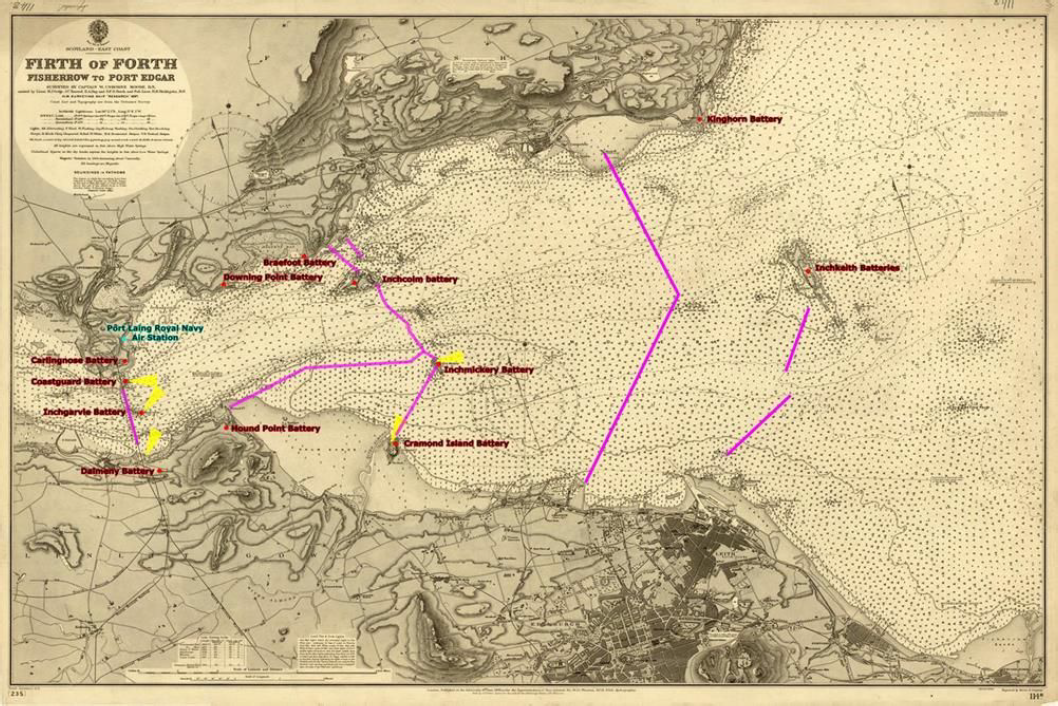
Location of gun batteries and anti-ship/submarine boom nets in 1917
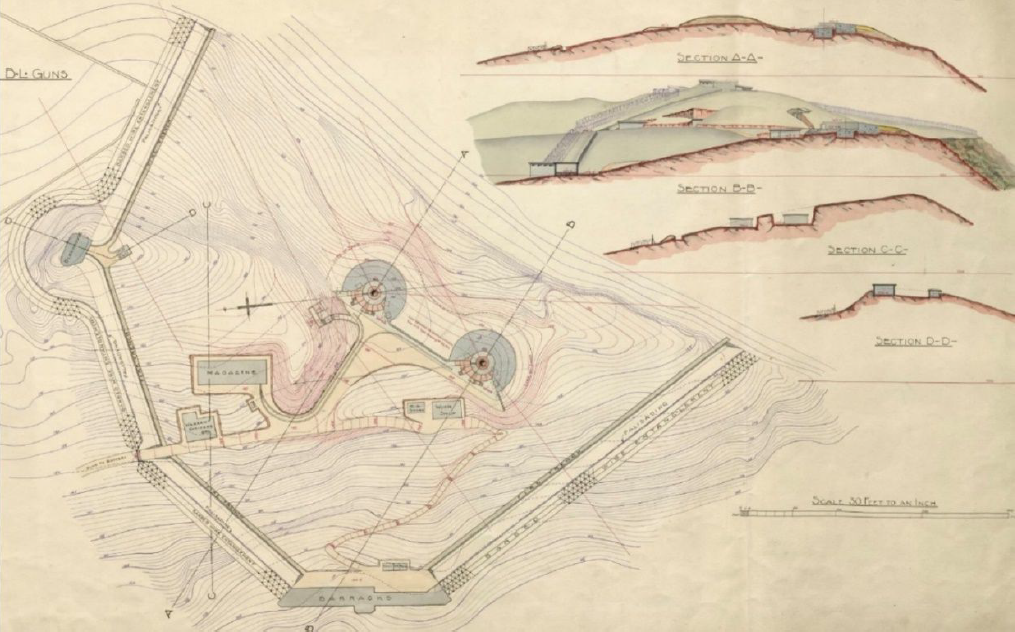
Original Braefoot Battery plans dated 1912

Battery Defences
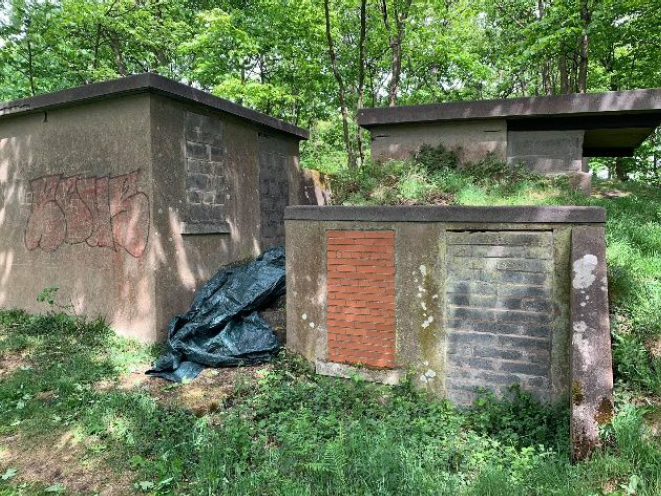
To guard against any land-based attack, the battery was well defended by brick and concrete blockhouses. Defences consisted of an outer ring of six blockhouses (red dots) and an inner ring of four blockhouses (blue dots) see map 4 and Pic 3. The main barrack block is shown in Pic 4 (blue line) was also fortified and loop holed to serve as a defensive structure. The inner ring was
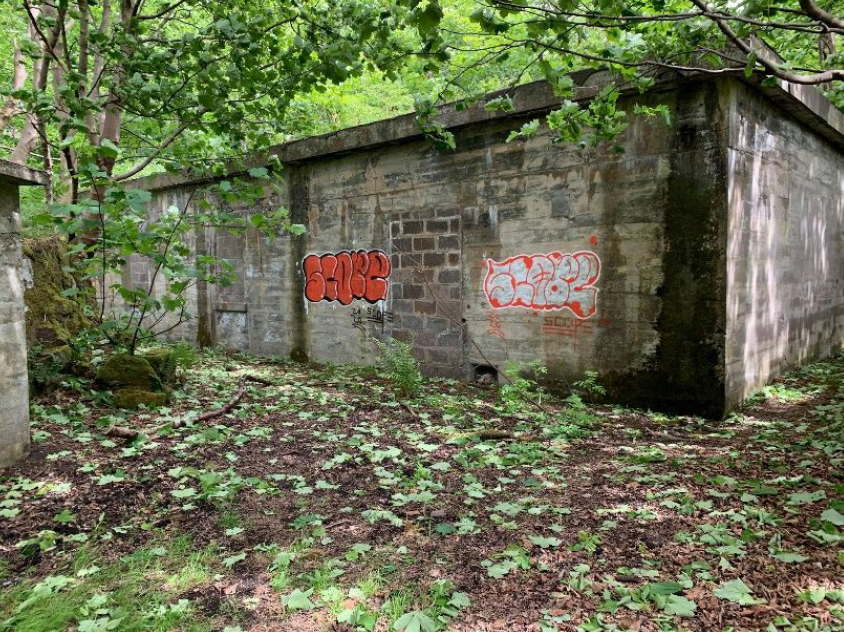
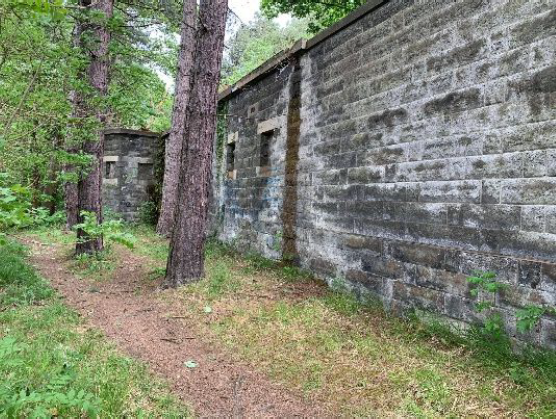
complemented with a barbed wire entanglement and wicker fence (black line) and a 10ft high wooden palisade fence (brown line). All of the inner blockhouses still stand today however some of the outer blockhouses have been demolished. The fixing for the main palisade gate can still be seen on the path just before the Warrant Officer’s Quarters, see Pic 5.
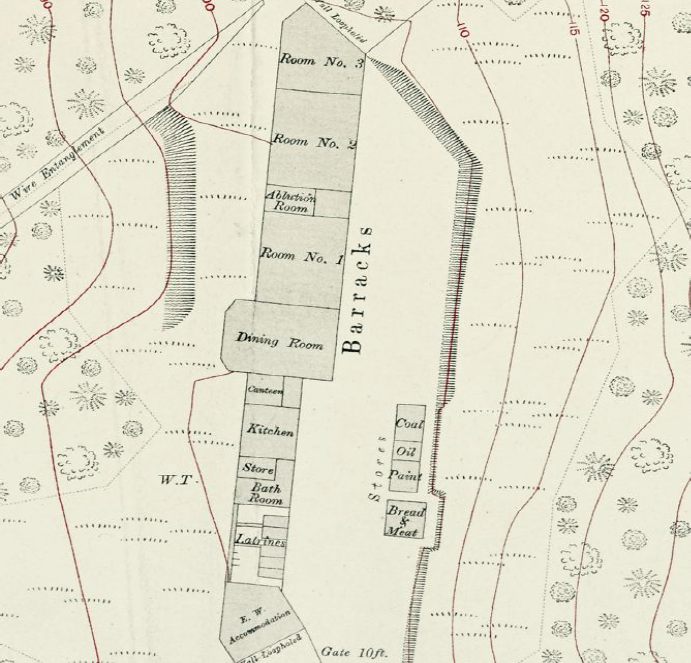
Map 5 – Main Barrack Block and Stores
The Main Barrack Block is the largest surviving structure on the site and markings can still be seen on the barracks and the nearby stores shedding light on their original usage. The barrack block was loop holed and formed part of the inner line of defence for the battery. It consisted of 3 rooms for the enlisted men, an ablutions room, dining room, canteen, kitchen, store, bathroom, latrines, and a separate room at the Southern end for female member of the Women’s Army Auxiliary Corps
(WAAC). See Map 5
Map 6 – Main Barrack Block and Stores
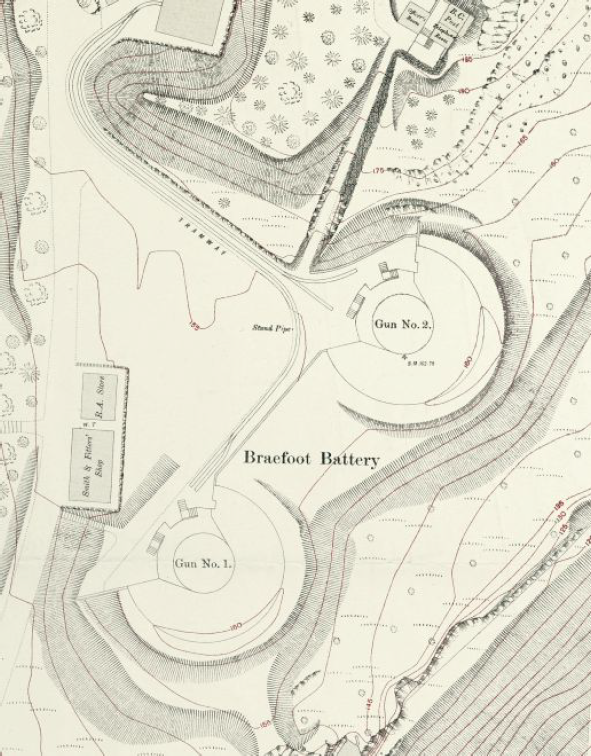
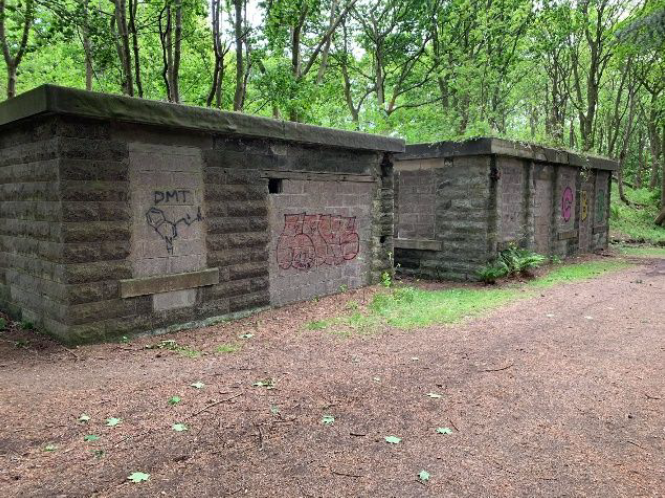
Shown on map 6 is the No.1 Gun and No.2 Gun emplacements face roughly South East and would have had an excellent view over the Forth prior to the more recent tree growth. The emplacements were connected to the Battery Magazine (Pic 6) by a small gauge tramway which was used to transport powder charge and shells to the guns. A Royal Artillery Store and Smith Fitters Shop stand nearby (Pic 7). The Battery Command Post stands to the North East of the gun emplacements with a co-located Telephone Room and Officer’s Room (Pic 8).

Map 7 – Battery Magazine
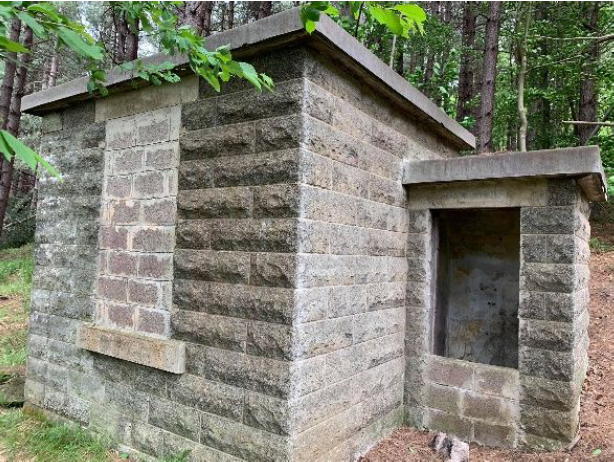
The first structures reached when visiting the site today are the Warrant Officer’s Quarters, Battery Magazine and Lamp Room. The Magazine is a substantial building which would have stored the powder charge and shells for the guns. Due to the volatile nature of the powder charges, it was necessary to have strict controls and a specific Lamp Room to provide lighting. The Magazine makes good use of the surrounding natural features to provide an additional level of defence. A small gauge tramline runs a short distance from the Magazine down to the gun emplacements, see Map 7.

Map 8 – Southern End of the Site
To the South of the Main Barrack Block was a series of ancillary buildings including a Storeroom, Royal Artillery Office, Sergeants Room, Recreation Room, Ablutions and Cook House. Further South lay the Officer’s Quarters and Officers Cookhouse. Most of these buildings have not survived. The Telephone Exchange (Pic 9) still stands and is clearly marked on the doorway. The pier at the end of Braefoot Point was constructed alongside the battery to enable resupply. (Map 8)

Map 9 – North East of the Site
To the North East of the site lies the largest remaining Blockhouse (No.4 Inner Ring) and one of the Position Finding (P.F.) Cells. The P.F. Cell (Pic 10) was used to accurately plot the position of a target vessel. Just outside the inner defence ring lay a complex of additional buildings used to house the resident infantry who guarded the site. These were temporary wooden structures and have not survived, see Map 9.
The Heritage Trail team would like to thank Mike Brown for this excellent article and other past contributions. We welcome him to the team



STEEPLE CLUMP
Contributor: Michael Brown, RCAHMS (DE)
This is the first episode of many concentrating on our military connections. Donibristle Airfield was operational from 1918 to 1959 and played a key part of our defence during both World Wars and we will detail over the coming months the important role it played.
As with all key military assets like the airfield or important infrastructure like the Forth Rail Bridge there is a need to build air defences to counteract any attack from enemy aircraft and in further episodes, we will cover the defences at Downing Point and Braefoot Bay.
However, one defence is less well known and that is the ‘Steeple Clump AAA Battery’ the War Office designated it as RNG1. This heavy anti-aircraft battery was manned in 1940 by the 71st (Forth) Heavy Anti-Aircraft Regiment, Royal Artillery.
It consisted of four gun-emplacements with sunken magazines between each of them. The station had a command position, an accommodation block and to the immediate SW an accommodation camp.
By 1942 the battery had four 4.5 – inch Anti-Aircraft guns placed at Steeple Clump, near where Morlich Place is today and by 1943 a GL mk.11 gun laying radar was situated between Crow Wood and where Morlich Crescent is today.
In 1945 as the risks changed the guns were reduced from the 4.5 inch to 3.7-inch.
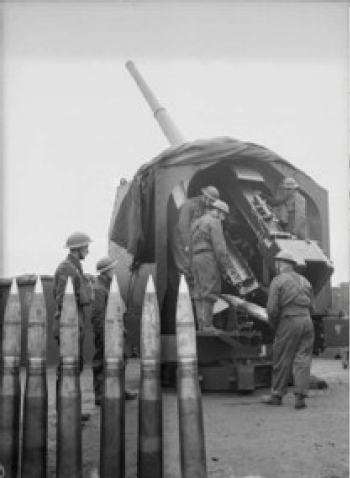
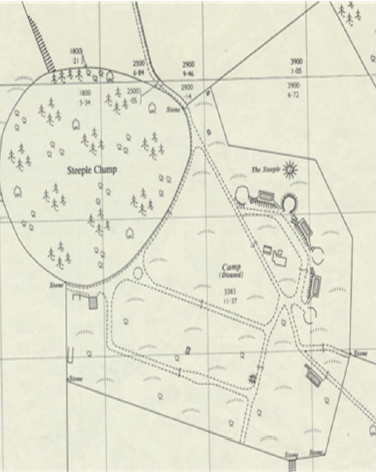


A battery of four 4.5” Anti Aircraft guns was established in 1942 at Steeple Clump (near Morlich Place today). A GL mk.II gun laying radar was situated near Crow Wood/Morlich Crescent.
Manned by 71st (Forth) Heavy Anti-Aircraft Regiment, Royal Artillery
The battery was later reduced to 3.7” guns in 1945
Information from RCAHMS (DE) July 1996
This heavy anti-aircraft battery was equipped with radar and the Gl-mat was situated in an area between Crow Wood (NT 1530 8352) and Morlich Crescent now part of a new housing estate. A vertical air photograph taken in 1945 (106G/UK/983, 4351, flown November 1945) shows that the battery was still armed at this date. Four gun-emplacements with sunken magazines located between each position, command position and the accommodation camp to the immediate SW. In addition, two possible light anti-aircraft emplacements are visible on the air photograph.
Information from RCAHMS (DE), September 2002.
Donibristle heavy anti-aircraft battery was designated RNG1 by the War Office and Public Record Office documents show that it was armed with four 4.5-inch guns between 1942 and 1943 with a GL Mk II radar unit being supplied in the latter year. The gun armament had been altered by May 1945 to four 3.7-inch Mk VI guns with no radar unit. Manning in 1940 was by 36 Brigade as part of 71 Regiment.
Reminiscence of Donibristle Base
Contributor – George Hastie recorded a conversation with Mr Nisbet (Cowdenbeath 1995)
Mr. Nisbet was born in 1918 and worked in the Donibristle Pit as an electrician. His experience was with 500 volt and 3,000-volt HT lines. He applied for the RAF when war broke out but had asthma, so he was put to work in Donibristle Airfield from 1942 – 1958. Then he moved to Gosport till 1979 and then to Almond Bank, Perth as he didn’t want to work in the Rosyth Dockyard. He was 21 when the war was declared. Despite his experience with HT lines, they didn’t recognise his qualifications, though men with experience of small electrical apparatus like cinema projectors, were accepted readily. “If they knew Ohm’s law, they got in.”
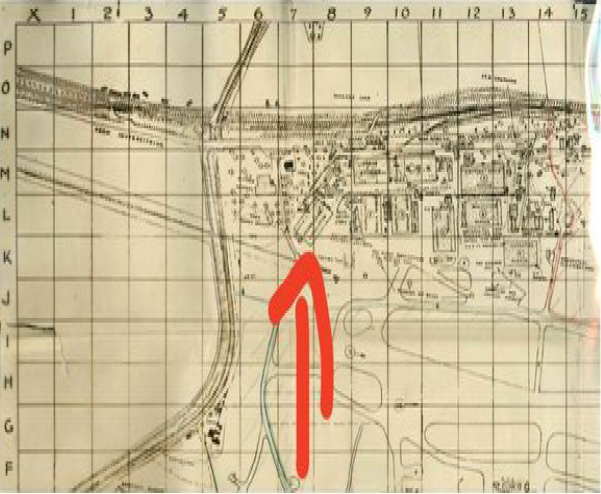
Most of his work in Donibee was with fine wiring. He was an ‘electrical charge hand’ in charge of fitters. There were 6 hangars. He was in Hangar F; (before flying test). There were air frame fitters, electrical fitters and instrument fitters, an engine repairs shop, a doping shop for the canvas framed planes and there were test beds. F Hangar was near the Hillend entrance, beyond the administration buildings, (pics 1 and 2.)
Pic 1

Pic 2
There was a runway, but it was short and thought unsuitable for jets. Down south at Fleetwood, where he worked later, there was no air strip and planes were towed to Lee on Solent. At Donibee, some aircraft did go by road to Rosyth Dockyard, but most flew out. Some supplies came in by railway and there were wagon ways (railways) within the yard. (Fraser Avenue, Inverkeithing, was built in 1959 with a wide street and no street lighting columns, only wall mounted lights, to let planes with folded wings be brought down the street in wagons to the pier at Inverkeithing Bay, if necessary, as in the first world war. That
was never needed as the Base closed soon around that time.
Mr. Nisbet never saw Donibristle House servant wings, nor the Bay (waterside) while he worked there during the war. The storage area was down there over the runways. He was up by the gates in a busy hangar (and probably eager to get home at 8pm). Shortly after the war, he worked with helicopters. Sometimes, he went up with the pilots to diagnose faults or to see if their procedures were wrong. Otherwise, they gave a description of faults or their diagnosis of faults in their 700 reports.
Donibristle’s imposing gates on the Hillend to Aberdour road had security police from the Dockyard. The perimeter security was OK at night, but pilfering was rife. Things were made for home. Called homers or rabbits and included TV ariels (from aluminium tubing) and toys. There was a market for shaped shepherd’s crooks in a kind of Bakelite and overseers would turn a blind eye to toys etc, if they were given some too. There was an air display at Lathalmond once and 50-gallon drums of fuel had to be sent up and workers tried to intercept them for their own cars. Axles and tyres from old planes were in demand from
farmers after the war for their trailers, there was a shortage of rubber for new tyres.
ROUTINE WORK AT DONIBRISTLE
Work was plentiful and money not short in the war years. He was not aware of a ‘push on’ for the war effort, as their work was routine servicing of aircraft, especially those on aircraft carriers. These were subject to corrosion. Planes were brought in, their engines over hauled, undercarriages tested, and corrosion treated. Swordfish biplanes had their canvases treated with dope’ to stiffen them. Albacore biplanes were similarly treated, there was a special dope shop. They worked a 7-day week, 7-15 to 5pm but often extended to 8pm. At night they disconnected the electrics and reported the hangars safe to the military police before
they left.
In wartime, there was a compulsory workers order, so many were employed, some just as labourers. People were bussed in from Lochgelly, Cowdenbeath and Crossgates down the B916 to Hillend. The busses were clapped out and sometimes needed a push up the hill to the north road. People cycled in. Trains ran to Hillend Halt (Donibristle) from Kirkcaldy, Inverkeithing and Edinburgh. In the 1947 snow, January 21st-March 20th, they were deep drifts on all the roads and railway cuttings. No appearance meant no wages, but the Base made allowances for the bad weather eventually. Some people tried to walk from
Crossgates but couldn’t because of the height of snow. Generally, there was a good social life and people went to outings, dances etc; and the hangars had football teams.
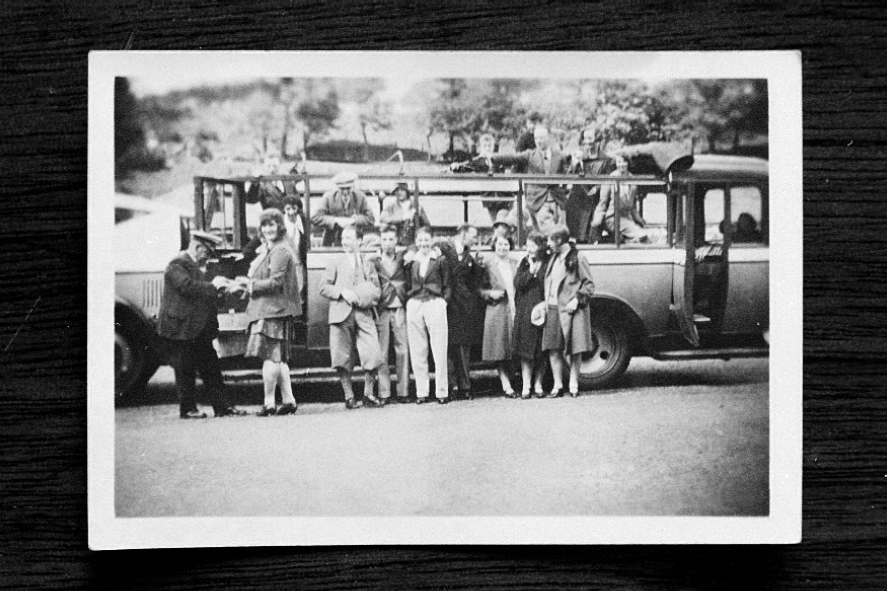
Pic 3: Airfield Outing credit George Hastie
There was a huge fuselage hangar where planes came for repairs. Amphibian Walrus aircraft had to have their wings folded to get in (pic 4). Post war, American planes were serviced there, like the Avenger, which had an electrically operated gun turret. It had a dead man’s handle and when that was released, the turret would ‘home’ to the tail position. Only in this position, could a gunner get out through the hatch to the fuselage.
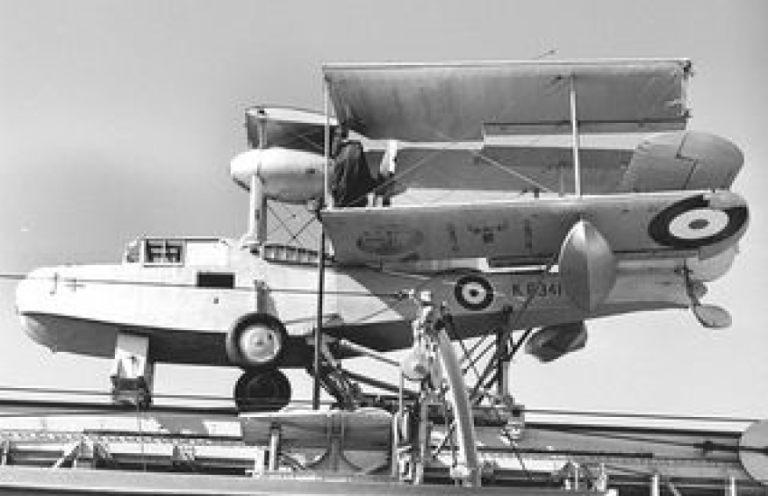
Pic 4: Amphibian Walrus with folded wings
Mr Nisbet had 10 fitters and 1 instrument fitter in his team (pic 5). When Admirals came on inspection, everything had to be tidied and polished, which meant no work done the day before, in preparation. Women worked as fitters, both on the air frame and electrical side. Generally, they were better than the men on intricate nuts and bolts. They disliked work at heights, however, such as navigation lights but he felt they were better at fine complex work, especially in accurately wiring cables with many different coloured wires inside.
His father grew up in Donibristle village where he worked in 2 pits. The locals had an out crop of coal for their own use, but he didn’t remember too much about the village as he grew up in Cowdenbeath.
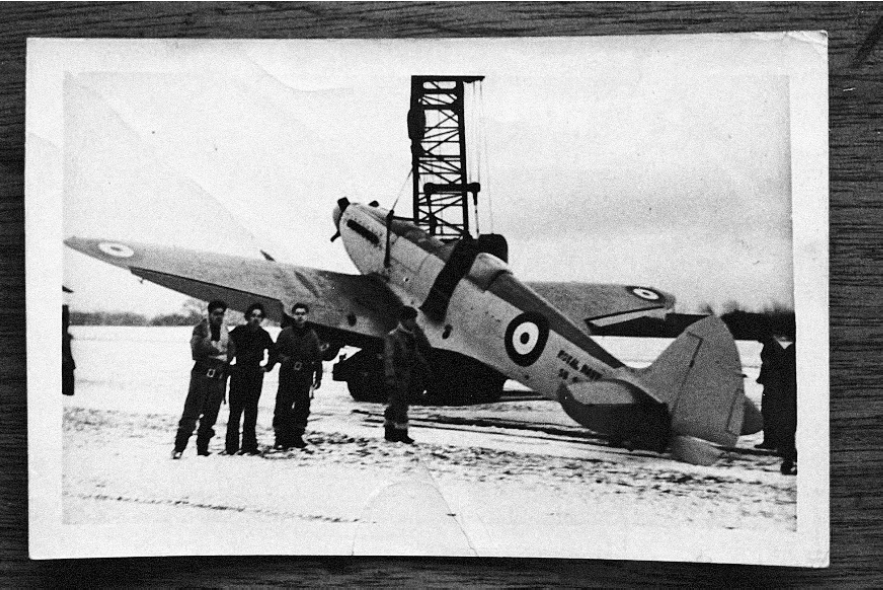
Pic 5: Fitters